
The Room Was Full. Then the Real AI Questions Started.
239 people registered for our AI Readiness Lab at the Military Influencer Conference. What happened once they started building reinforced something I’ve been thinking about for months: the most important questions about AI often aren’t really about AI.
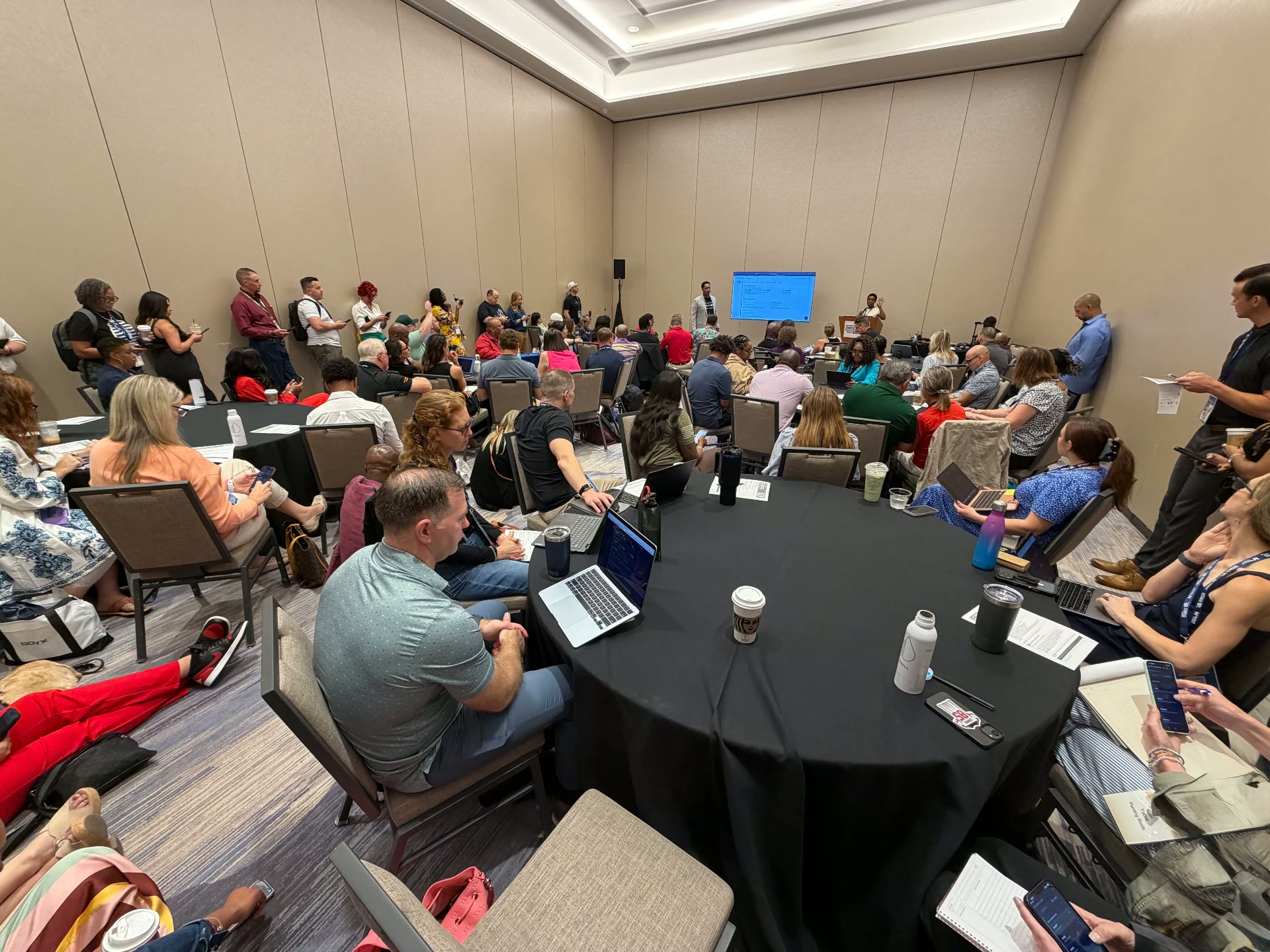
By the time we started there wasn’t another chair to give to anybody. People stood along the back wall and the side walls. People sat on the floor near the front while others grabbed a spot in the aisle with their laptops open and tried to work from there.
And there were still people we couldn’t get into the room.
239 attendees had registered for the AI Readiness Lab John Thomas and I were co-facilitating at the Military Influencer Conference.
I remember looking out at the room and having two thoughts at once:
Wow. And: This is what we prepared for.
(To be clear, we weren’t expecting the bodies-on-the-floor part...)
John and I had decided pretty early that we didn’t want to give another sit-and-listen AI presentation.
People don’t need another workshop with somebody standing in front of a screen telling them AI is changing everything — they know. We wanted to create space for them to work. So we designed an in-app experience that took attendees through four stages:
Define → Build → Systemize → Extract
Participants would clarify some foundational business information, use that context to create an asset, preserve the information so it could become reusable, and leave with one specific next action.
The structure mattered.
Because my work lives primarily in strategy, positioning, messaging and business context and John’s expertise lives in systems, automation, AI builds and implementation. We wanted people to experience both sides.
A strategy that never gets implemented isn’t useful, but the ability to build faster doesn’t solve the problem if you haven’t decided what deserves to be built.
We challenged people to slow down before we pushed them to speed up.
The first phase was ‘Define’ and I told the room upfront that they would have to think a little bit here. We didn’t start with “write me a landing page”, we started with questions about the business.
- 01What do you do?
- 02Who do you actually want to serve?
- 03What do those people need or want to change?
- 04Why should they choose you?
- 05How should this brand behave and communicate?
That information would eventually become their Brand Snapshot and provide context for what they built next, but the exercise was doing something else too — reducing the number of blanks AI would have to fill for them.
AI is very good at filling blanks, sometimes too good. Give it incomplete business context and it doesn’t stop and tell you that you haven’t thought things through.
If AI were human it would infer (basically it’s doing “math” after you give it an instruction and fills in the gaps...) and those inferences can sound very convincing.
That’s why I told the room:
Polished doesn’t automatically mean strategic.
AI can produce a beautiful expression of a poorly defined idea, so we slowed down.
I feel like one of the interesting things about AI is that its ability to help us move faster is what makes the thinking that happens before execution more important. Before AI can understand your brand, somebody inside the organization has to understand the brand first.
Then somebody asked about landing pages.
Once attendees moved into the ‘Build’ phase, we started generating landing-page prototypes.
And twice, people asked some version of:
Where does this fit if I already have a website?
One attendee wondered whether sending people to a landing page might reduce traffic to the main website. Fair question, so I gave them an egg explanation.
A website can be the whole house. If I tell you the eggs are somewhere in my house, you may need to walk through the front door, turn into the kitchen, find the refrigerator, open it and locate the eggs.
A landing page can be the door to get the eggs.
It’s not necessarily replacing the house...it’s giving someone a more direct path to a specific thing. Maybe you’re asking them to register, download something, buy, join or take one next step.
The right answer depends on the strategy.
AI answered how quickly we could build something, but it couldn’t answer where the asset should live and what job it should do. That’s still human responsibility.
Then somebody asked about client information.
Another person in the room asked about using AI when you’re working with client data, and this conversation moved us into a completely different part of AI adoption.
Governance. Responsibility. Boundaries.
My starting point was simple: if your industry already has standards for protecting or handling information, those standards don’t disappear because a new tool becomes available. Start there, but regulation doesn’t cover every decision a business will face.
There may still be questions about proprietary information, customer conversations, internal documents, team access, what gets entered, and what requires approval.
That’s where organizations need their own right and left limits and I think values can play a practical role here.
If your organization says it values trust, what does trustworthy AI use look like?
If you value stewardship, what information should never be loaded into a system even when you technically could?
If you value human dignity, where do you want a person — not an automated process — making the call?
Responsible AI doesn’t rest on only what a platform allows; what an organization decides is the most important guardrail in my opinion.
The technology surfaced the decisions.
Once participants started building, they ran into the questions that don’t usually show up in an AI demonstration. Instead of asking what a tool can do, they pondered questions like: Should this be the thing we build?
Where does it fit?
What information should it have?
Does this sound like us?
Would we actually use this?
Where does a person need to remain involved?
These are strategic, operational governance, and human-focused questions. AI doesn’t remove any of them...in a lot of ways it makes them more urgent.
Using AI isn’t the same thing as being AI ready.
Before the conference, we polled attendees about how they were already using AI and the majority were regular users. Some had built workflows or automations. Others were already using AI across their businesses or organizations.
That’s important to note because I don’t believe the next stage of AI adoption is convincing people to try the technology, I believe it’s helping them build the judgment to use it well.
An organization can have dozens of employees using AI and still lack a shared understanding of:
- 01what the brand stands for,
- 02what information is approved,
- 03where AI creates value,
- 04which decisions require humans,
- 05and what “good” use actually looks like.
Without that shared intelligence, AI can scale inconsistency just as efficiently as it scales clarity.
One person feeds one tool one version of the business; another person gives another system a different context. A contractor invents something else and suddenly you have five versions of the brand moving at machine speed.
That’s not readiness....that’s faster fragmentation.
What I think AI fluency actually requires
I don’t think AI fluency is knowing every new tool because the tools, interfaces and even the companies will change......the capabilities certainly will.
What lasts is the ability to think underneath them. That looks like understanding the business well enough to give the technology useful context, recognizing when an output is technically accurate but strategically wrong.
Fluency also means determining when automation creates leverage and when it creates risk. This is the work I’m increasingly interested in, but not AI for AI’s sake. I want AI to be in service of organizations that know who they are, what they’re trying to accomplish and what they aren’t willing to surrender along the way.
239 people registered for our lab. And yes, seeing people on the floor with laptops open because they wanted to participate was one of those moments I’m going to remember for a long time.
But the most encouraging part wasn’t how many people wanted to use AI...it was what happened when they did. They asked better questions and as the questions became elevated, it became clearer that even though the technology is changing the work, it hasn’t relieved us of the responsibility to decide what good work looks like.
If your organization is already using AI but hasn’t yet defined how it fits into your strategy, workflows and decision-making, that’s the work I help teams navigate.